YouTube Premium Price Per Month 2026: Cost, Plans & Is It Worth It?
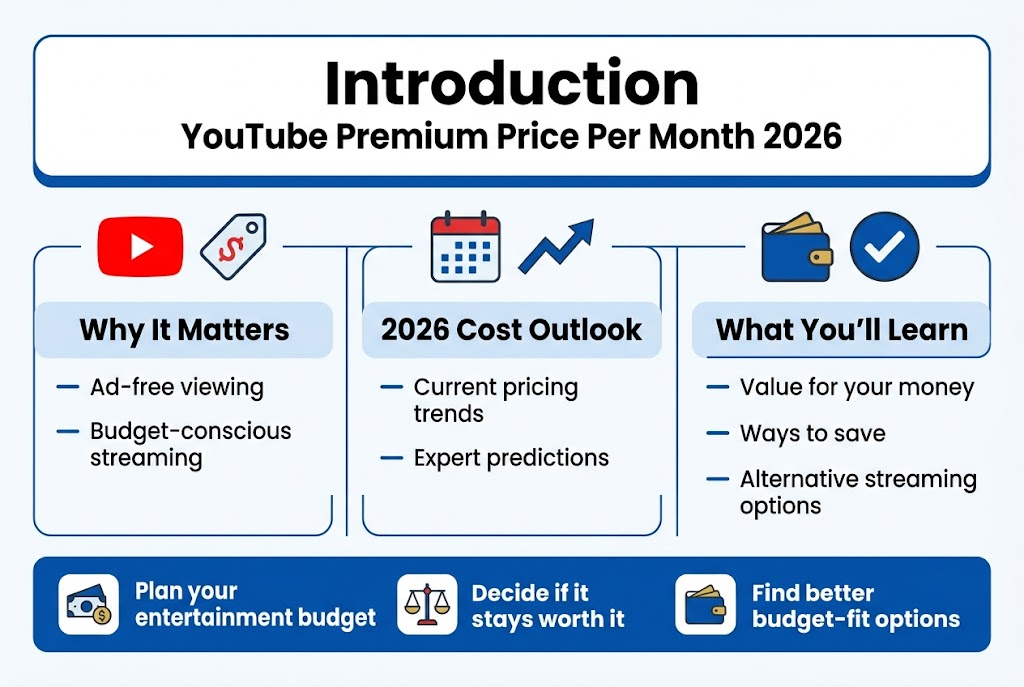
YouTube Premium subscribers and budget-conscious streamers want to know what they’ll pay for ad-free viewing in 2026. With subscription costs climbing across all platforms, understanding youtube premium price per month 2026 projections helps you plan your entertainment budget and decide if the service stays worth it.
This guide breaks down current pricing trends and expert predictions for YouTube Premium’s 2026 costs. We’ll explore how much value you’ll get for your money and share practical ways to save on your subscription. You’ll also discover alternative streaming options that might better fit your budget and viewing habits.
Current YouTube Premium Pricing Structure and Historical Trends
Monthly subscription rates across different regions
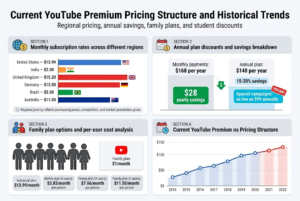
YouTube Premium pricing varies significantly across global markets, with regional pricing strategies reflecting local purchasing power and competitive landscapes. In the United States, the standard monthly subscription currently sits at $13.99, while countries like India offer substantially lower rates at approximately $2.00 per month. European markets typically see pricing between $11-15 monthly, with the UK at £11.99 and Germany at €11.99.
Regional price differences stem from YouTube’s localized pricing strategy, which considers factors like average income levels, local competition, and market penetration goals. Emerging markets often receive aggressive pricing to drive adoption, while mature markets with established user bases face higher rates.
| Region | Monthly Price (USD Equivalent) | Local Currency |
|---|---|---|
| United States | $13.99 | USD |
| India | $2.00 | ₹149 |
| United Kingdom | $15.20 | £11.99 |
| Germany | $13.50 | €11.99 |
| Brazil | $3.50 | R$16.90 |
| Australia | $11.50 | AU$16.99 |
Annual plan discounts and savings breakdown
YouTube Premium offers annual subscription options in select markets, providing meaningful savings compared to monthly billing cycles. The annual plan typically delivers 15-20% savings, translating to roughly two months free when compared to monthly payments.
For example, in markets offering annual billing, subscribers pay approximately $140 annually instead of $168 through monthly payments, creating a $28 yearly savings. This discount structure encourages long-term commitment while reducing payment processing costs for Google.
The savings become more attractive when combined with promotional periods. New subscribers often receive discounted first-year rates, sometimes as low as $99 annually during special campaigns. These promotional rates significantly impact the value proposition and user acquisition strategies.
Family plan options and per-user cost analysis
Family plans represent YouTube Premium’s most cost-effective option for households with multiple users. The family subscription accommodates up to six members, creating substantial per-user savings compared to individual subscriptions.
In the US market, family plans cost $22.99 monthly, delivering a per-user rate of approximately $3.83 when fully utilized. This represents a 73% savings compared to individual subscriptions at $13.99 each. The math becomes compelling for families with three or more active YouTube users.
Family plan members receive identical benefits to individual subscribers, including ad-free viewing, background play, and YouTube Music access. The plan administrator manages member invitations and can remove users as needed, providing flexibility for changing household dynamics.
Per-user cost comparison:
- Individual plan: $13.99/month
- Family plan (6 users): $3.83/month per person
- Family plan (3 users): $7.66/month per person
- Family plan (2 users): $11.50/month per person
Student pricing tiers and verification requirements
Student discounts offer significant savings for eligible college and university students, typically providing 50% off standard subscription rates. In the US, student pricing currently sits at $6.99 monthly, requiring annual verification through third-party services like SheerID.
Verification requirements include enrollment in accredited higher education institutions, maintaining active student status, and providing documentation such as student ID cards or enrollment letters. The verification process typically takes 24-48 hours and requires annual renewal to maintain student pricing.
Geographic availability of student plans varies, with broader availability in developed markets and limited options in emerging economies. Some regions offer student plans through local partnerships with educational institutions, creating market-specific verification processes and pricing structures.
Student subscribers receive identical service features to standard premium users, making this tier particularly attractive for price-sensitive demographics. The substantial discount often serves as an entry point for long-term YouTube Premium adoption, with many users transitioning to standard pricing after graduation.
Predicted YouTube Premium Price Changes for 2026
Industry inflation impact on streaming service costs
Streaming platforms across the board have been adjusting their pricing strategies to match broader economic trends, and YouTube Premium is no exception. The subscription service market has seen consistent price increases since 2020, with Netflix, Disney+, and Hulu all implementing multiple rate hikes within just a few years.
Economic factors continue to drive these changes. Production costs for original content have skyrocketed, with streaming companies now spending billions annually on exclusive shows and movies. YouTube’s investment in YouTube Originals and premium features requires substantial funding, which typically translates to higher subscription fees.
Looking at YouTube Premium’s pricing history, the service launched at $9.99 per month in 2015 and has already increased to $13.99 in many regions. Following industry patterns, the youtube premium price per month 2026 could realistically reach $16.99-$18.99, representing a gradual but consistent upward trend.
Operational expenses have also surged. Server maintenance, bandwidth costs, and content delivery networks require massive infrastructure investments. YouTube serves over 2 billion logged-in monthly users, making their operational scale unprecedented and expensive to maintain.
Enhanced feature rollouts justifying price increases
YouTube has been aggressively expanding Premium features beyond basic ad removal. Recent additions include background play, YouTube Music integration, and exclusive access to certain creators’ content. By 2026, subscribers can expect even more premium perks that could warrant higher pricing.
AI-powered personalization features are already in development, promising smarter content recommendations and customized viewing experiences. These technologies require significant research and development investments, costs that typically get passed to consumers.
YouTube Shorts monetization has become a major focus, with Premium subscribers potentially receiving exclusive editing tools and priority placement in feeds. Enhanced livestreaming capabilities, including higher quality streams and interactive features, are also on the roadmap.
Content creation tools represent another value addition. Premium subscribers might gain access to professional editing software, advanced analytics, and collaboration features that compete directly with standalone creative platforms.
Competition-driven pricing strategies from rival platforms
Spotify Premium Family plans and Apple One bundles have set new benchmarks for subscription value propositions. YouTube must balance competitive pricing while maintaining profitability, especially as rivals continue expanding their offerings.
Amazon Prime Video’s inclusion in Prime memberships creates pricing pressure, forcing YouTube to demonstrate clear value beyond what free alternatives provide. Netflix’s ad-supported tier launch has also influenced how streaming services approach pricing tiers.
TikTok’s potential premium service launch could significantly impact YouTube’s strategy. Social media platforms are increasingly monetizing through subscriptions rather than just advertising, creating new competitive dynamics.
Regional pricing variations will likely become more pronounced by 2026. Markets like India, Brazil, and Eastern Europe may see different rate structures compared to North American and Western European pricing, reflecting local purchasing power and competitive landscapes.
Value Proposition Analysis for 2026 Subscription Costs
Ad-free viewing experience and time savings calculation
When evaluating the youtube premium price per month 2026, the ad-free experience stands out as the most immediate benefit. The average YouTube user encounters 6-8 ads per hour of viewing, with each ad ranging from 5-30 seconds for skippable content and up to 15 seconds for non-skippable ads. For heavy users watching 3-4 hours daily, this translates to approximately 15-20 minutes of ads per day.
Converting time to monetary value reveals compelling math. Assuming a modest $15 hourly wage equivalent for personal time, those 15-20 minutes daily represent $3.75-$5.00 in time value. Monthly, this adds up to $112-$150 in reclaimed time, making even projected 2026 pricing increases seem reasonable by comparison.
Beyond raw time savings, the psychological benefits of uninterrupted viewing create additional value. Studies show that ad interruptions reduce content comprehension by 25-30% and significantly impact user satisfaction scores.
YouTube Music inclusion and standalone service comparison
YouTube Premium’s bundled music service becomes increasingly attractive when compared to standalone alternatives. Spotify Premium currently costs $10.99 monthly, while Apple Music charges $10.99, and Amazon Music Unlimited runs $8.99 for Prime members.
By 2026, these standalone music services will likely reach $12-14 monthly. YouTube Premium’s projected pricing means subscribers essentially pay $3-5 extra for the entire YouTube ad-free experience while getting comparable music streaming capabilities.
| Service | 2024 Price | Projected 2026 Price | Music Library Size |
|---|---|---|---|
| Spotify Premium | $10.99 | $12.99 | 100+ million tracks |
| Apple Music | $10.99 | $12.99 | 100+ million tracks |
| YouTube Music (standalone) | $10.99 | $12.99 | 100+ million tracks |
| YouTube Premium (includes Music) | $13.99 | $16.99-$18.99 | 100+ million tracks |
YouTube Music’s unique advantage lies in its access to unofficial uploads, live performances, and rare tracks that traditional streaming services don’t offer. This expanded catalog often includes content unavailable elsewhere, making the bundled offering particularly valuable for music discovery enthusiasts.
Premium-exclusive content and original programming access
YouTube’s investment in original programming has grown substantially, with exclusive series, documentaries, and creator-produced content available only to Premium subscribers. By 2026, this library will likely expand significantly as YouTube competes more directly with Netflix and Disney+ for premium content.
Current Premium exclusives include continuation episodes of popular series, behind-the-scenes content from major creators, and early access to anticipated releases. Creators with millions of subscribers increasingly offer Premium-only content as an additional revenue stream, making the subscription valuable for fans of specific channels.
The early access feature lets Premium subscribers watch new uploads from their favorite creators before general release, sometimes by several hours or even days. For trending content and breaking news channels, this early access provides significant value to engaged viewers.
Download capabilities and offline viewing benefits
Offline viewing capabilities become particularly valuable for users with limited data plans or frequent travel. YouTube Premium allows downloads of videos up to 1080p quality, with content remaining accessible for 30 days offline.
For commuters spending 1-2 hours daily on public transportation, offline viewing eliminates data usage concerns while ensuring entertainment availability regardless of connection quality. International travelers save substantially on roaming charges by pre-downloading content before trips.
The download feature supports entire playlists and series, making it practical for long flights or areas with poor connectivity. Educational content creators particularly benefit subscribers who can download tutorials, lectures, and how-to videos for offline reference.
Smart download features automatically save new episodes from subscribed channels when connected to Wi-Fi, ensuring fresh content availability without manual intervention. This automation proves especially useful for daily commuters who maintain consistent viewing routines.
Battery life improvements also result from offline viewing, as streaming typically consumes 20-30% more battery power than playing downloaded content. For mobile-heavy users, this efficiency gain extends device usage between charges.
Money-Saving Strategies for YouTube Premium Access
Annual subscription discounts versus monthly payments
Smart subscribers can slash their YouTube Premium costs significantly by choosing annual billing over monthly payments. Based on current pricing patterns and expected 2026 rates, annual subscribers typically save 15-20% compared to monthly billing cycles. If the youtube premium price per month 2026 reaches $15-18, annual subscribers might pay the equivalent of just $12-14 monthly.
The math works in your favor when committing to a full year. YouTube often sweetens annual deals with promotional pricing, especially during holiday seasons or back-to-school periods. Setting up automatic annual renewal prevents price hikes that affect monthly subscribers first – YouTube typically grandfathers existing annual subscribers for their full billing period.
Consider your viewing habits before committing. Heavy users who watch YouTube daily and rely on background play or offline downloads will easily justify annual payments. Casual viewers might prefer monthly flexibility despite higher costs.
Family plan sharing optimization techniques
Family plans deliver exceptional value when maximized properly. A single YouTube Premium Family subscription covers up to six accounts, making the per-person cost dramatically lower than individual subscriptions. With projected 2026 pricing, family plans could cost $25-30 monthly, working out to just $4-5 per person when fully utilized.
Key optimization strategies:
- Choose the primary account holder carefully – Select someone with stable payment methods and long-term YouTube usage
- Mix household members and trusted friends – Family plans don’t require actual family relationships
- Coordinate shared benefits – Pool YouTube Music libraries and share downloaded content recommendations
- Monitor usage patterns – Remove inactive members and add new users to maximize value
Cost comparison breakdown:
| Plan Type | 2026 Projected Cost | Per Person (6 users) | Monthly Savings vs Individual |
|---|---|---|---|
| Individual | $15-18 | $15-18 | N/A |
| Family | $25-30 | $4-5 | $10-13 per person |
Family plan managers should establish clear ground rules about account sharing and ensure all members understand the payment schedule to avoid disruptions.
Student discount eligibility and application process
Students can access YouTube Premium at roughly 50% off regular pricing through verified educational discounts. Current student pricing around $7-8 monthly suggests 2026 rates might reach $8-10, still representing substantial savings compared to standard subscriptions.
Eligibility requirements typically include:
- Active enrollment at an accredited college or university
- Valid .edu email address or equivalent international student verification
- Age verification (usually 18+ or legal adult status)
- Geographic restrictions may apply in certain regions
The application process involves submitting educational documentation through YouTube’s student verification partner. Students upload transcripts, enrollment letters, or student ID photos for manual review. Approval usually takes 2-5 business days, and discounts last for up to four years with annual re-verification.
Pro tips for student subscribers:
- Apply early in your academic career to maximize discount duration
- Set calendar reminders for annual re-verification deadlines
- Keep multiple forms of student documentation ready for quick renewal
- Consider family plan sharing if you have multiple student friends
Graduate students, part-time students, and online degree seekers often qualify, making this discount accessible to various educational paths. International students should check regional availability, as student discounts vary by country and may require local educational verification systems.
Alternative Options and Competitive Pricing Comparison
Free YouTube with ad-blockers versus Premium subscription
Using ad-blockers on free YouTube creates an interesting alternative to paying for Premium, but the comparison gets complicated when you factor in effectiveness and ethics. Popular ad-blockers like uBlock Origin and AdBlock Plus can eliminate most video advertisements, giving you an ad-free experience without the monthly cost. However, YouTube continuously updates its systems to detect and counter ad-blocking software, leading to an ongoing cat-and-mouse game.
The main drawbacks of relying on ad-blockers include potential account restrictions, reduced video quality options, and missing Premium features like offline downloads and background playback on mobile devices. YouTube has become increasingly aggressive about blocking users who employ ad-blockers, sometimes requiring viewers to disable their extensions before watching content.
From a creator support perspective, ad-blockers prevent revenue sharing with content creators, while Premium subscriptions provide creators with a portion of subscription fees based on watch time. This ethical consideration becomes more relevant as creators rely heavily on advertising revenue for their livelihood.
Spotify Premium and Apple Music pricing benchmarks
Streaming music services offer valuable pricing context for YouTube Premium’s 2026 positioning. Spotify Premium currently costs $10.99 monthly for individuals, while Apple Music charges $10.99 for the same tier. These platforms focus exclusively on audio content, making YouTube Premium’s video-centric offering appear competitively priced despite potentially higher costs.
| Service | Individual Plan | Family Plan | Student Plan |
|---|---|---|---|
| Spotify Premium | $10.99/month | $16.99/month | $5.99/month |
| Apple Music | $10.99/month | $16.99/month | $5.99/month |
| YouTube Premium (Current) | $13.99/month | $22.99/month | $7.99/month |
The value proposition differs significantly across these platforms. While Spotify and Apple Music excel in music discovery and audio quality, YouTube Premium combines ad-free video streaming, YouTube Music access, and exclusive content. This bundled approach justifies the premium pricing structure, especially considering the vast content library and creator ecosystem.
Bundle deals with other Google services evaluation
Google’s ecosystem approach creates compelling package deals that can reduce the effective cost of YouTube Premium. Google One subscriptions, which include cloud storage, family sharing capabilities, and various Google service perks, sometimes feature YouTube Premium credits or discounted rates.
The Google Play Pass bundle occasionally includes YouTube Premium access alongside app subscriptions and game unlocks. For families heavily invested in Google services—using Gmail, Google Drive, Google Photos, and Android devices—these bundles provide substantial value beyond individual service pricing.
Student discounts through Google for Education partnerships can reduce costs significantly, while regional pricing variations make YouTube Premium more accessible in certain markets. Corporate and enterprise packages sometimes include YouTube Premium as part of broader Google Workspace subscriptions, effectively distributing costs across business operational expenses.
Comparing bundle pricing against individual subscriptions reveals potential savings of 20-30% for users who actively utilize multiple Google services, making the ecosystem approach increasingly attractive as individual service costs rise.
Conclusion
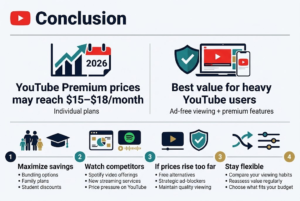
YouTube Premium’s pricing will likely continue its upward trend through 2026, with analysts predicting monthly costs could reach $15-18 for individual plans. While this represents a significant increase from current rates, the enhanced features and ad-free experience may still provide solid value for heavy YouTube users. The key is weighing your viewing habits against the rising costs to determine if the subscription makes financial sense for your situation.
Smart subscribers should explore bundling options, family plans, and student discounts to maximize their savings. Keep an eye on emerging competitors like Spotify’s video offerings and new streaming services that might pressure YouTube to reconsider aggressive price hikes.
If the costs become too steep, free alternatives and strategic ad-blockers can help you maintain a quality viewing experience without breaking the bank. The streaming landscape changes quickly, so staying flexible with your subscriptions will serve you well in the years ahead.




Post Comment