How to Calculate Overtime and Net Paycheck for Hourly Employees: Avoid Costly Payroll Mistakes (2026 Guide)
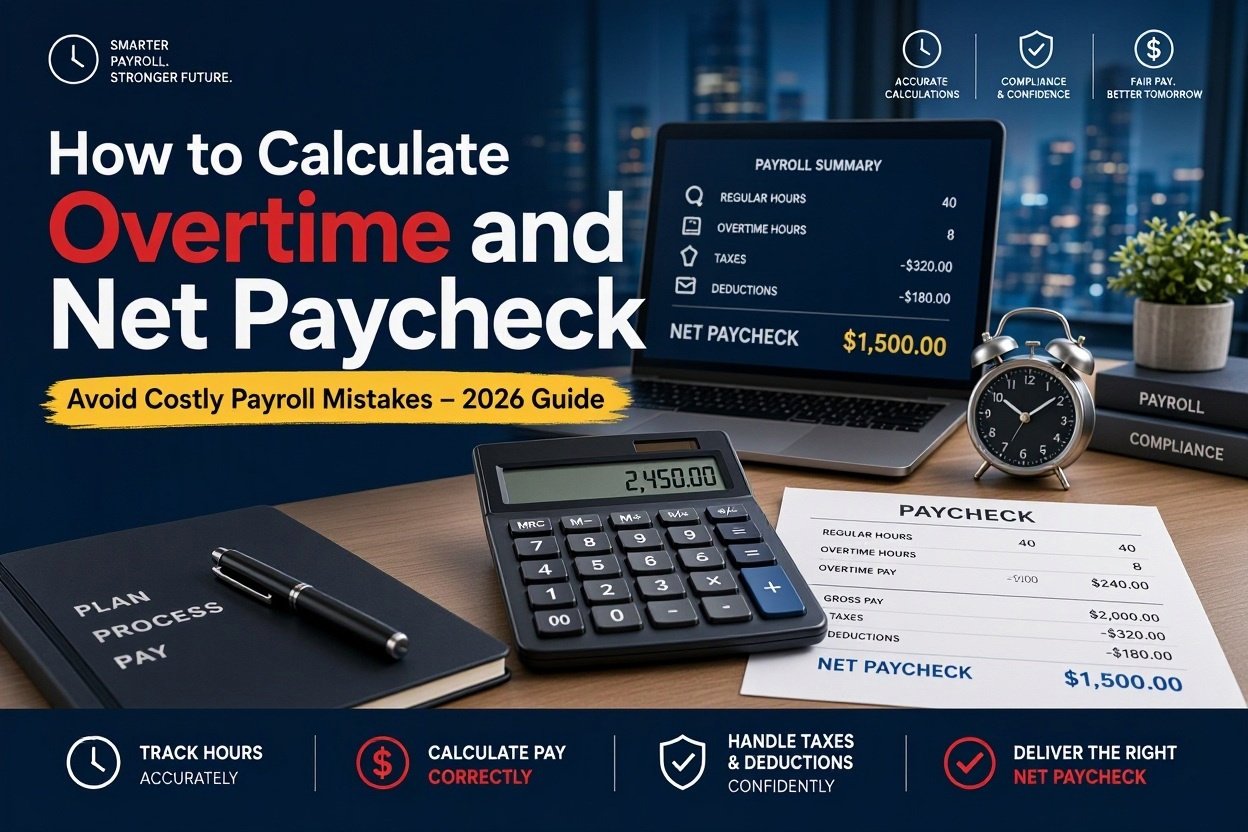
Knowing how to calculate overtime and net paycheck for hourly employees is one of those practical skills every small business owner, operations manager, and bookkeeper needs to get right the first time. If you have ever had an hourly team member walk up to your desk on Friday afternoon asking why their direct deposit looks twenty dollars short, you already know how fast a small spreadsheet mistake can hurt team trust.
Under federal Fair Labor Standards Act (FLSA) overtime rules, non-exempt hourly staff must earn at least 1.5 times their regular rate of pay for every hour worked beyond 40 in a single workweek. Where most businesses trip up is not the basic 1.5x multiplication—it is figuring out what counts toward that “regular rate” when bonuses are involved, handling biweekly schedules without illegally averaging hours, and taking out the right payroll taxes before cutting the final check.
In this practical guide, we will walk through a real-world payroll calculation from start to finish. You can follow the math step by step below and double-check your own numbers anytime using the free Paycheck Calculator on NovaBizTech.
Why Learning How to Calculate Overtime and Net Paycheck for Hourly Employees Matters
When you run payroll manually or copy formulas from an old spreadsheet, two small habits usually cause the biggest headaches:
- Averaging hours across a two-week pay period instead of closing out overtime at the end of each seven-day workweek.
- Multiplying the base hourly wage by 1.5 while forgetting to roll weekly attendance or production bonuses into the employee’s regular rate first.
When you know how to calculate overtime and net paycheck for hourly employees using a clean, repeatable workflow, you stop second-guessing every pay run. Let’s break down the exact five-step process we use to take an hourly timesheet from raw clock-in hours to net take-home pay.
Step 1: Lock In a Fixed 168-Hour Workweek Before You Calculate Overtime and Net Paycheck
Before touching a calculator, you have to define when your company’s workweek starts and ends. According to the U.S. Department of Labor elaws Overtime Advisor, a workweek is a fixed, recurring period of 168 consecutive hours (seven 24-hour days). It does not have to run from Sunday to Saturday—you can set yours from Monday at 12:00 AM to Sunday at 11:59 PM if that matches your shift schedule.
Once that window is set, each week stands completely on its own. Even if you pay your team every two weeks (biweekly), you cannot blend a slow week and a busy week together to avoid paying overtime.
Here is a classic real-world example we see all the time:
- Week 1: Your technician clocks 36 hours.
- Week 2: A rush order comes in, and the same technician clocks 44 hours.
- Total Biweekly Hours: 80 hours across the two-week pay period.
If you simply pay 80 straight-time hours because the biweekly total equals 80, your payroll is out of compliance. To calculate overtime and net paycheck totals properly, you must pay 36 straight-time hours for Week 1, plus 40 straight-time hours and 4 overtime hours for Week 2. Also keep in mind that under DOL Fact Sheet #23, even if an employee works unauthorized overtime against company policy, you are still legally required to pay them 1.5x for those extra hours—you can address the policy violation through coaching, but never by docking their earned overtime pay.
Step 2: How to Calculate Overtime and Net Paycheck for Hourly Employees With Bonuses
If an employee only earns a flat hourly wage with zero incentives, overtime is simple: multiply their hourly rate by 1.5 for every hour over 40.
However, as explained in DOL Fact Sheet #56A, an employee’s “regular rate of pay” includes more than just their base wage. Whenever you offer non-discretionary bonuses—like a weekly on-time attendance reward, a shift differential, or a production target bonus covered under DOL Fact Sheet #56C—that bonus money must be spread across all hours worked that week before you calculate the overtime premium.
Real-World Example: Calculating Gross Pay With a Weekly Bonus
Let’s walk through a concrete example with realistic numbers so you can see how the math actually works in practice.
Suppose you employ a shift lead named Bilal at USD 22.00 per hour. During a busy week, Bilal works 45 hours and hits his team’s weekly output target, earning a USD 90.00 production bonus. Here is how you calculate his gross paycheck:
- 1. Calculate base straight-time wages for all hours worked: Multiply 45 hours by USD 22.00/hour = USD 990.00.
- 2. Add the non-discretionary bonus: Add USD 990.00 + USD 90.00 bonus = USD 1,080.00 total straight-time compensation.
- 3. Find the true regular hourly rate for the week: Divide USD 1,080.00 by all 45 hours worked = USD 24.00 per hour. (Notice how the bonus raised his effective regular rate from USD 22.00 to USD 24.00 for this specific week.)
- 4. Calculate straight-time pay for the first 40 hours: Multiply 40 hours by USD 24.00/hour = USD 960.00.
- 5. Calculate 1.5x overtime pay for the 5 extra hours: Multiply USD 24.00 by 1.5 to get an overtime rate of USD 36.00/hour, then multiply by 5 overtime hours = USD 180.00.
- 6. Add them together for Total Gross Pay: USD 960.00 + USD 180.00 = USD 1,140.00 gross weekly paycheck.
If you had simply multiplied his USD 22.00 base rate by 1.5 (USD 33.00 x 5 hours) and tacked on the USD 90.00 bonus at the end, Bilal’s check would have been USD 1,135.00—leaving him short by USD 5.00 and putting your payroll records out of alignment.
Step 3: Check Salaried vs. Non-Exempt Rules When You Calculate Overtime and Net Paycheck
One of the most expensive myths in small business management is thinking that putting someone on a fixed weekly salary automatically makes them exempt from overtime.
Under DOL Fact Sheet #17A, a salaried employee is only exempt from overtime if they pass both the federal job duties test (genuinely managing a department, exercising independent administrative judgment, or working in a recognized professional role) and the federal salary threshold test. When you review how to calculate overtime and net paycheck for hourly employees and junior salaried coordinators, always check whether a salaried office assistant or shift supervisor is actually non-exempt—because if they are non-exempt, every hour they work past 40 still requires overtime pay.
Step 4: Subtract 2026 Payroll Taxes to Calculate Overtime and Net Paycheck Take-Home Pay
Once you have the employee’s gross paycheck figure (USD 1,140.00 in our example above), the next step is converting gross pay into the net take-home amount that lands in their bank account.
For 2026 payroll runs, federal withholding rules in IRS Publication 15 (Circular E) require employers to deduct FICA taxes (Social Security and Medicare) alongside federal income tax calculated from the employee’s W-4 form.
| Deduction or Tax Item | 2026 Federal Rate & Rule | How It Applies to Our USD 1,140.00 Gross Example |
|---|---|---|
| Social Security Tax | 6.2% withheld from the employee (and matched 6.2% by the employer) up to the USD 184,500 annual wage cap in IRS Publication 15. | 1,140.00 x 0.062 = USD 70.68 deducted from the employee’s check. |
| Medicare Tax | 1.45% withheld from the employee (and matched 1.45% by the employer) on all wages with no annual cap under IRS Publication 15. | 1,140.00 x 0.0145 = USD 16.53 deducted from the employee’s check. |
| Federal Income Tax Withholding | Calculated using the employee’s Form W-4 elections and the percentage or wage-bracket tables in IRS Publication 15-T. | Varies by filing status (Single, Married, Head of Household) and qualified overtime adjustments on Form W-4. |
| 1099 Freelancers vs. W-2 Staff | Independent contractors are not subject to W-2 FICA withholding and submit separate bills per IRS Publication 15-A. | Keep contractor payouts out of hourly payroll—create clean client or contractor bills using the free Invoice Generator on NovaBizTech. |
Finishing the Net Paycheck Math
Let’s finish Bilal’s weekly paycheck calculation using the numbers from the table above:
- Gross Weekly Earnings (40 regular hours + 5 OT hours + bonus): USD 1,140.00
- Minus Social Security (6.2%): – USD 70.68
- Minus Medicare (1.45%): – USD 16.53
- Take-Home Pay Before Federal/State Income Tax & Benefits: USD 1,052.79
From this USD 1,052.79 subtotal, you simply subtract the employee’s specific federal and state income tax withholding based on their Form W-4 (plus any voluntary pre-tax health or retirement contributions) to arrive at their exact net direct deposit. Rather than doing this subtraction by hand every Friday, you can punch the gross pay and tax rate straight into the Paycheck Calculator on NovaBizTech to get an instant breakdown.
Step 5: How to Fix a Past Payroll Mistake Without Panicking
Even experienced bookkeepers occasionally spot an overtime miscalculation or a tax withholding slip-up after payday has already passed. If you discover an error while reviewing how to calculate overtime and net paycheck for hourly employees, fixing it proactively is always cheaper than waiting for a quarterly notice:
- Make the employee whole on the very next check: If you underpaid overtime because a bonus was left out of the regular rate, calculate the exact difference, pay it out immediately, and note the prior pay period adjustment clearly on the employee’s pay stub.
- Correct same-year tax withholding mistakes promptly: As outlined in the IRS employment tax correction guide, federal income tax withholding errors can generally be adjusted within the same calendar year the wages were paid, and any overcollected tax must be reimbursed to the employee before December 31.
- File Form 941-X for prior quarterly returns: If a calculation mistake affected a quarterly Form 941 that you already submitted, you can file an amended Form 941-X electronically to square up your employer tax record.
Frequently Asked Questions (FAQ)
What is the fastest way to calculate overtime and net paycheck for hourly employees?
Start by separating each fixed seven-day workweek. Add the employee’s weekly base wages and any non-discretionary bonuses together, divide by total hours worked to find their regular rate, multiply that rate by 1.5 for any hours over 40, and then deduct 6.2% for Social Security, 1.45% for Medicare, and W-4 income taxes.
Can an employee agree to waive overtime pay in exchange for extra hours?
No. Under DOL Fact Sheet #23, overtime pay rights cannot be waived by agreement between an employer and an employee. Any hours worked beyond 40 in a workweek by a non-exempt worker must be paid at 1.5 times their regular rate.
Is overtime pay taxed at a higher rate than regular hourly pay?
No—overtime pay is taxed under the same federal income tax brackets and the same 7.65% combined Social Security and Medicare (FICA) rate as regular wages. It sometimes feels like overtime is taxed more heavily only because a larger single paycheck can push that week’s automated withholding into a slightly higher bracket under IRS Publication 15-T.




Post Comment